
Why UPSC Preparation Feels Overwhelming for Beginners?
Every year, lakhs of aspirants begin their UPSC Civil Services preparation journey with excitement, fear, confusion, and endless questions:
- Where should I start?
- Which books should I read?
- Is coaching necessary?
- Can an average student crack UPSC?
- How many hours should I study?
- How do toppers prepare?
- Is UPSC preparation different from college studies?
The internet is flooded with strategies, booklists, YouTube videos, and “secret formulas.” Instead of clarity, beginners often experience information overload.
The truth is simple:
UPSC is not cracked by collecting more resources.
It is cracked by building:
- conceptual clarity,
- disciplined execution,
- revision systems,
- analytical thinking,
- and long-term consistency.
The Civil Services Examination is not merely a knowledge test. It evaluates:
- awareness,
- judgment,
- balance,
- writing ability,
- administrative thinking,
- and emotional resilience.
That is why many academically average students succeed while highly intelligent candidates sometimes fail.
This guide is designed specifically for UPSC beginners preparing for 2027. It will help you:
- understand the exam,
- avoid beginner mistakes,
- create a preparation roadmap,
- build a realistic study system,
- master NCERTs,
- integrate current affairs,
- and prepare strategically from Day 1.
Unlike generic strategy articles, this guide integrates:
- PYQ trends,
- aspirant psychology,
- modern preparation systems,
- revision frameworks,
- and exam-oriented execution.
Table of Contents
What Is The UPSC Civil Services Examination?
The UPSC Civil Services Examination (CSE) is conducted annually by the Union Public Service Commission to recruit officers for services such as:
- IAS
- IPS
- IFS
- IRS
- IAAS
- and several Group A & B services.
UPSC CSE is considered one of the toughest competitive examinations in the world because it tests:
- depth of understanding,
- multidisciplinary thinking,
- consistency,
- writing ability,
- and personality traits.
Understanding The UPSC Exam Structure
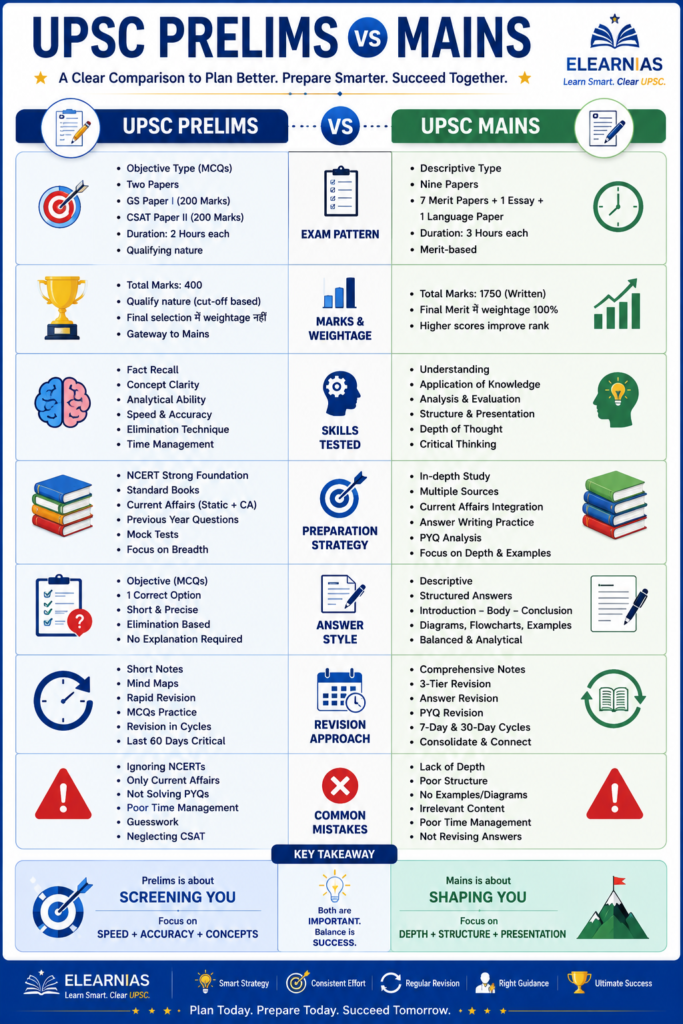
Complete comparison between UPSC Prelims and UPSC Mains including exam pattern
preparation strategy, revision approach, skills tested, and common mistakes..
Stages of the UPSC Exam
To understand how to prepare effectively, beginners must first understand the structure and demands of each stage of the examination.
1. Preliminary Examination (Objective)
Papers
- GS Paper I
- CSAT (qualifying)
Nature
- Objective MCQs
- Negative marking
- Elimination-heavy
What Prelims Tests
- Conceptual understanding
- Interdisciplinary awareness
- Intelligent elimination
- Current affairs integration
Recent PYQs show that UPSC increasingly asks analytical and application-oriented questions instead of factual memorization.
2. Mains Examination (Written)
Papers
- Essay
- GS1
- GS2
- GS3
- GS4
- Optional Subject (2 papers)
- Language papers
What Mains Tests
- Analytical writing
- Critical thinking
- Governance understanding
- Ethical reasoning
- Structured presentation
- Recent GS papers increasingly focus on:
3. Personality Test (Interview)
The interview does not test memorized information.
It evaluates:
- administrative temperament,
- communication,
- emotional balance,
- integrity,
- judgment
What UPSC Actually Tests
Most beginners think UPSC rewards:
- rote learning,
- massive study hours,
- or intelligence alone.
That is incorrect.
UPSC primarily rewards:
- consistency,
- conceptual understanding,
- clarity,
- revision,
- and analytical thinking.
Can A Beginner Crack UPSC?
Beginner Mindset Before Starting UPSC Preparation
The Biggest Myth:
“Only Toppers Crack UPSC”
Many aspirants believe:
- IIT graduates dominate UPSC,
- English-medium students have an advantage,
- or only extraordinary people succeed.
Reality:
Thousands of selected candidates come from:
- rural backgrounds,
- Hindi-medium schools,
- state universities,
- working-class families.
UPSC is less about brilliance and more about disciplined preparation.
Why Average Students Often Succeed
Average students usually:
- follow structured plans,
- revise repeatedly,
- avoid overconfidence,
- and remain consistent longer.
Highly intelligent aspirants sometimes fail because they:
- underestimate revision,
- ignore answer writing,
- overconsume resources,
- or lack consistency.
UPSC Preparation Is a Marathon
UPSC preparation is not a 3-month sprint.
It requires:
- emotional stability
- disciplined routines
- long-term planning
- and sustainable study habits
Why Most Beginners Fail in UPSC Preparation
Before learning how to prepare, you must understand why most aspirants fail.
This alone can save you months — even years.
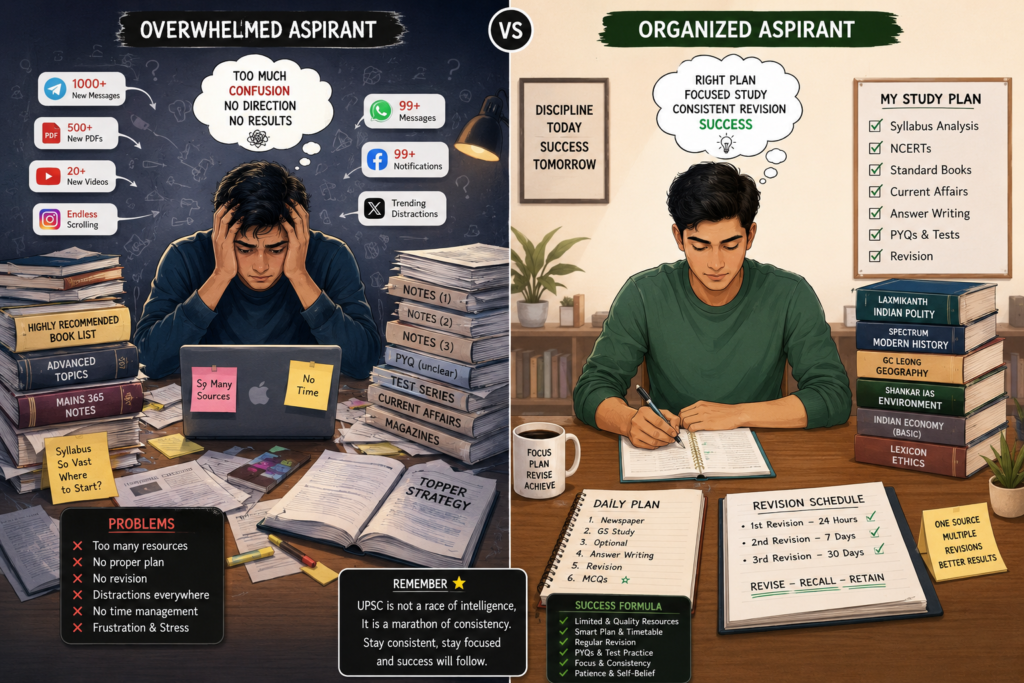
1. Resource Overload
One of the biggest beginner mistakes is collecting too many resources.
Aspirants often start with:
- 20 booklists,
- 10 YouTube channels,
- multiple coaching PDFs,
- Telegram material dumps,
- and endless current affairs compilations.
Result?
They study everything superficially and master nothing.
UPSC Reality:
UPSC rewards:
- depth,
- revision,
- and conceptual clarity.
Not resource collection.
2. Ignoring PYQs (Previous Year Questions)
Most beginners delay PYQ analysis.
This is a major mistake.
UPSC PYQs reveal:
- question patterns,
- conceptual priorities,
- elimination techniques,
- analytical depth,
- and recurring themes.
For example, recent UPSC papers repeatedly test:
- environment,
- governance,
- climate change,
- federalism,
- technology,
- and interdisciplinary understanding.
Without PYQs, preparation becomes directionless.
3. Lack of Revision
Most beginners keep studying new things.
Very few revise properly.
But UPSC is fundamentally a revision-heavy exam.
The aspirant who revises 5 books five times often performs better than the aspirant who reads 50 books once.
4. Passive Studying
Watching lectures continuously without:
- recalling,
- writing,
- revising,
- solving questions,
creates an illusion of preparation.
Real UPSC preparation requires:
- active recall,
- answer writing,
- MCQ solving,
- and self-testing.
5. Unrealistic Expectations
Many beginners think:
- “I’ll crack UPSC in 6 months.”
- “I must study 15 hours daily.”
- “Toppers never feel demotivated.”
This creates burnout.
UPSC is a marathon.
Consistency matters more than intensity.
UPSC Myths Beginners Must Ignore
Myth 1: You Need Coaching to Crack UPSC
False.
Thousands clear through self-study.
False.
- structure,
- mentorship,
- discipline.
But it cannot replace:
- self-study,
- revision,
- consistency.
Myth 2: Only Toppers with Exceptional Intelligence Clear UPSC
False.
UPSC is more about:
- discipline,
- planning,
- emotional stability,
- and consistency.
Myth 3: You Must Study 15 Hours Daily
Effective focused study for 6–8 hours consistently
is far better than 15 hours of distracted studying.
How To Start UPSC Preparation From Zero
Step-by-Step UPSC Preparation
This is the most important part of the preparation journey.
Most beginners fail because they start preparation randomly.
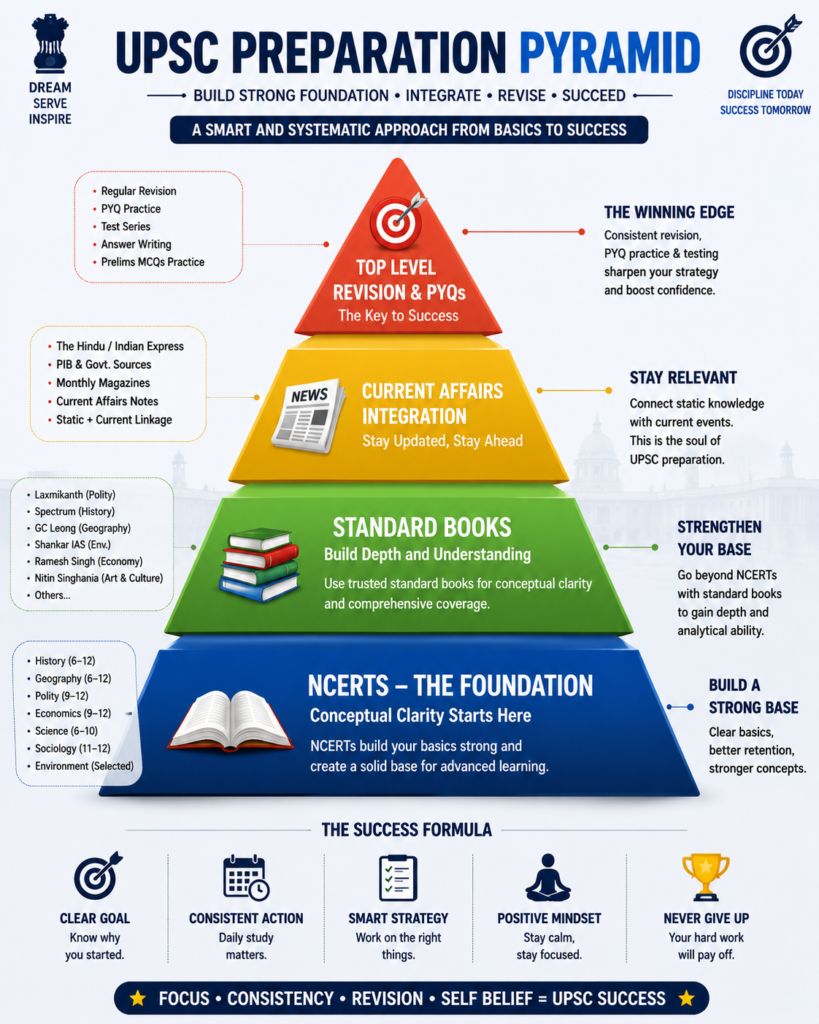
Follow this sequence carefully.
Step 1: Understand the UPSC Syllabus
Download:
- UPSC Prelims syllabus
- UPSC Mains syllabus
Read them repeatedly.
The syllabus acts as:
- your roadmap,
- preparation boundary,
- and revision framework.
Step 2: Analyze PYQs
Before reading books, study previous year questions.
Analyze:
- question patterns,
- recurring themes,
- analytical depth,
- and UPSC priorities.
PYQs reveal that UPSC repeatedly focuses on:
- governance,
- federalism,
- sustainability,
- climate change,
- economy,
- ethics,
- and technology.
Step 3: Start With NCERTs
NCERTs build conceptual clarity.
Read:
- History NCERTs
- Geography NCERTs
- Polity basics
- Economics basics
- Science NCERTs
Do not rush.
Focus on understanding concepts.
Step 4: Move to Standard Books
After NCERTs:
- choose one standard source per subject,
- avoid multiple books,
- and revise repeatedly.
Step 5: Begin Current Affairs Preparation
Current affairs should be integrated with static subjects.
Choose:
- The Hindu
OR - Indian Express
Focus only on UPSC-relevant issues.
Step 6: Build Revision Habit
Revision is the backbone of UPSC preparation.
Without revision:
- retention collapses,
- preparation becomes passive.
Step 7: Start Answer Writing and MCQs Early
Do not wait for syllabus completion.
Begin:
- daily MCQs,
- short answer writing,
- and self-testing early.
Best Books For UPSC Preparation
Choosing limited resources is extremely important.
History
- Spectrum Modern History
- Old NCERTs
Geography
- NCERTs
- GC Leong
- Atlas
Polity
- M. Laxmikanth
Economy
- NCERT basics
- Economic Survey summary
- Budget summary
Environment
- Shankar IAS Environment
Ethics
- Lexicon
- Case study practice
Art & Culture
- Nitin Singhania
Important Rule
Avoid:
- collecting too many PDFs,
- reading multiple coaching notes,
- and changing sources repeatedly.
How To Study Current Affairs Properly
Current affairs preparation is often misunderstood by beginners.
UPSC does not expect memorization of daily news.
It expects:
- issue-based understanding,
- conceptual linkage,
- analytical thinking.
What To Read
Focus on:
- governance,
- judiciary,
- parliament,
- economy,
- environment,
- international relations,
- science & technology,
- social issues.
Avoid:
- political gossip,
- entertainment,
- sensational news.
Best Sources
- The Hindu / Indian Express
- PIB selective reading
- Monthly compilations
- Budget & Economic Survey
How To Make Current Affairs Notes
Keep notes:
- concise,
- issue-based,
- and revision-friendly.
Do not write newspaper summaries line by line.
UPSC Prelims Preparation Strategy
Prelims requires:
- conceptual clarity,
- elimination techniques,
- revision,
- and extensive MCQ practice.
Important Areas
- Environment
- Economy
- Geography
- Polity
- Science & Tech
- Current Affairs
Recent prelims papers show strong emphasis on:
- environment,
- ecology,
- geography mapping,
- governance,
- and conceptual economy questions.
Best Strategy
Daily
- 20–30 MCQs
Weekly
- sectional tests
Monthly
- full-length mocks
Golden Rule
Revision matters more than:
- collecting new material.
UPSC Mains Preparation Strategy
Mains is a test of:
- analytical depth,
- structure,
- and articulation.
Focus Areas
GS1
- History
- Society
- Geography
GS2
- Governance
- Constitution
- International Relations
GS3
- Economy
- Environment
- Security
- Technology
GS4
- Ethics
- Integrity
- Aptitude
Answer Writing Strategy
Every answer should include:
- introduction,
- body,
- conclusion.
Use:
- headings,
- examples,
- diagrams,
- constitutional references,
- committees,
- and current affairs integration.
PYQ Analysis Is Essential
Recent Mains PYQs increasingly demand:
- multidimensional thinking,
- governance perspective,
- sustainability approach,
- and interdisciplinary analysis.
UPSC CSAT Strategy
Many aspirants ignore CSAT.
This is dangerous.
CSAT has become increasingly difficult.
Important Areas
- Reading comprehension
- Logical reasoning
- Basic numeracy
- Decision making
Beginner Strategy
Practice regularly:
- comprehension passages,
- reasoning sets,
- and basic aptitude questions.
Especially important for:
- non-maths background students.
Daily Study Timetable For UPSC Aspirants
Consistency matters more than extreme study hours.
Timetable For Beginners
| Time | Activity |
|---|---|
| Morning | Newspaper + Current Affairs |
| Afternoon | Core GS Subject |
| Evening | Optional / MCQs |
| Night | Revision |
For Working Professionals
| Time | Activity |
|---|---|
| Morning | Current Affairs |
| Evening | GS Study |
| Weekend | Tests + Revision |
Ideal Study Hours
Quality matters more than quantity.
Initially:
- 5–6 focused hours are enough.
Gradually increase.
How Many Hours Should You Study For UPSC?
This is one of the most common beginner questions.
There is no magical number.
Recommended Study Hours
Beginners
4–6 focused hours
Full-Time Aspirants
6–8 quality hours
Working Professionals
3–5 weekdays
8–10 weekends
Important Point
Focused study matters more than:
- sitting long hours with distractions.
Best Online Resources For UPSC Preparation
Government Sources
- PIB
- PRS India
- Rajya Sabha TV / Sansad TV
- Economic Survey
- Budget Documents
Websites
- UPSC official website
- NCERT website
YouTube Channels
Use selectively for:
- conceptual clarity,
- current affairs analysis,
- and revision.
Avoid excessive content consumption.
Role Of NCERT Books In UPSC Preparation
How To Read NCERTs Properly
First Reading
Understand concepts.
Second Reading
Underline important points.
Third Reading
Revise actively.
Common Mistakes
Avoid:
- memorizing blindly,
- making excessive notes,
- rushing through chapters.
Revision Strategy For UPSC
Revision is the real game changer.
Most aspirants fail because they:
- keep reading new things,
- but rarely revise.
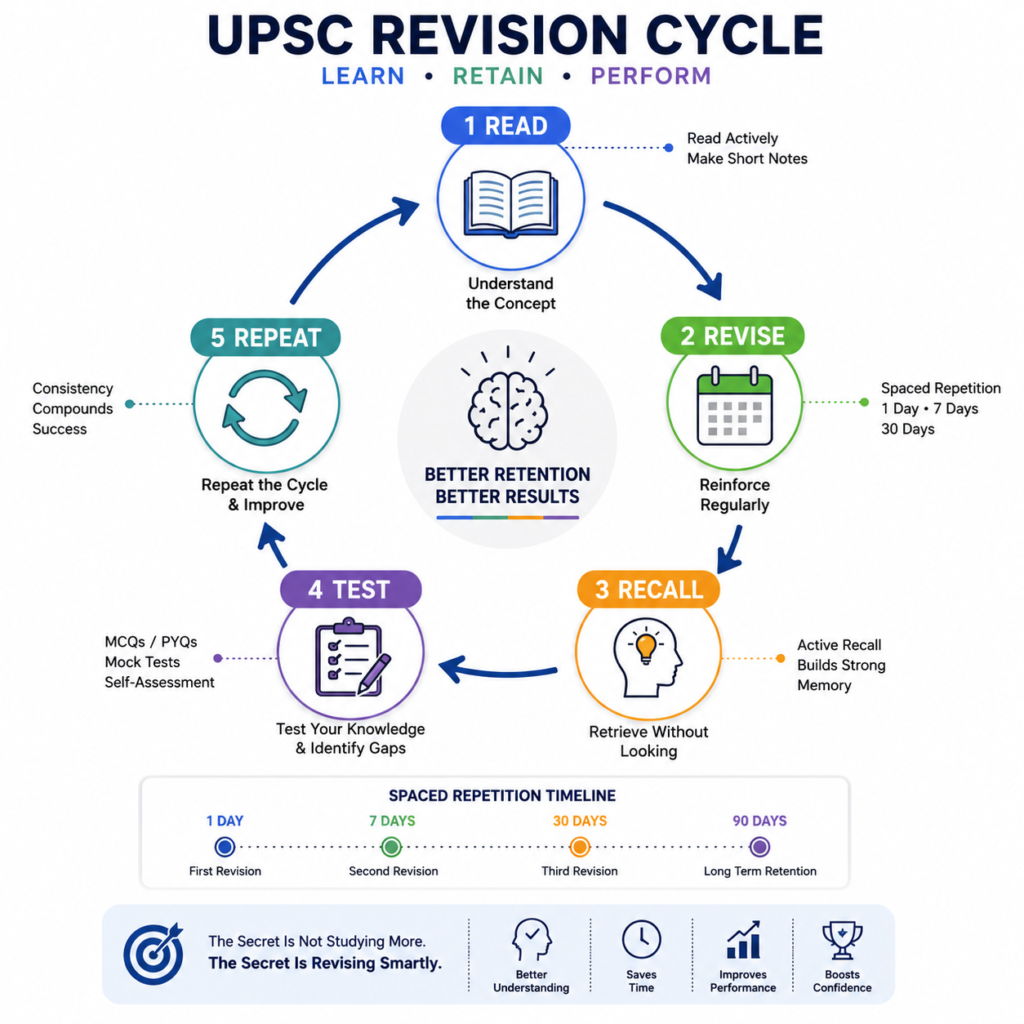
The 3R Formula
Read
Understand conceptually.
Revise
Repeat regularly.
Recall
Test yourself actively.
Suggested Revision Cycle
| Revision | Timeline |
|---|---|
| 1st | Within 24 hours |
| 2nd | Within 7 days |
| 3rd | Within 1 month |
Mock Tests And PYQs Strategy
Mock tests and PYQs are essential.
Why PYQs Matter
PYQs reveal:
- UPSC thinking,
- recurring themes,
- conceptual depth,
- and elimination logic.
Mock Test Strategy
Prelims
- weekly sectional tests,
- monthly full mocks.
Mains
- regular answer writing,
- timed practice,
- peer review if possible.
Golden Rule
Do not judge yourself emotionally after every mock.
Use tests for:
- diagnosis,
- correction,
- and improvement.
How To Stay Consistent During Preparation
Consistency is more important than motivation.
UPSC preparation is a long journey.
Avoid Burnout
Take:
- short breaks,
- proper sleep,
- light exercise,
- and healthy routines.
Avoid Social Media Traps
Major productivity killers:
- endless topper videos,
- Telegram addiction,
- comparison,
- fake productivity.
Build Systems Instead of Motivation
Success comes from:
- routines,
- habits,
- and discipline.
Expert Tips To Crack UPSC In First Attempt
1. Keep Resources Limited
Revise fewer books multiple times.
2. Prioritize PYQs
PYQs are the best teachers.
3. Focus on Revision
Revision creates retention.
4. Practice Writing Early
Mains rewards articulation.
5. Integrate Static + Current Affairs
UPSC increasingly asks interdisciplinary questions.
6. Stay Consistent
Daily effort matters more than occasional intensity.
Frequently Asked Questions
Can a beginner crack UPSC in first attempt?
Yes. Many successful UPSC toppers started their preparation as complete beginners. With proper strategy, disciplined preparation, conceptual clarity, revision, and consistent practice, even first-time aspirants can crack the UPSC Civil Services Examination.
How many hours should I study daily for UPSC?
There is no fixed number of study hours for UPSC preparation. Beginners should initially focus on consistency and productive study rather than counting hours. A disciplined 6–8 hour study schedule with revision and PYQ practice is more effective than long unproductive study sessions.
Which newspaper is best for UPSC preparation?
Most UPSC aspirants prefer reading The Hindu or The Indian Express for current affairs preparation. Along with newspapers, aspirants should also follow PIB, Yojana, Kurukshetra, Economic Survey, and Budget highlights selectively.
Are NCERT books enough for UPSC preparation?
NCERT books form the foundation of UPSC preparation, especially for beginners. However, aspirants must later supplement NCERTs with standard reference books, current affairs, PYQ analysis, mock tests, and answer writing practice.
Conclusion
Starting UPSC preparation from zero may seem overwhelming initially.
But remember:
Every successful IAS officer once started exactly where you are now.
Do not focus on:
- fear,
- competition,
- or social media pressure.
Focus on:
- syllabus,
- PYQs,
- revision,
- consistency,
- and disciplined execution.
UPSC is not cracked by:
- the smartest aspirant,
- or the one with the most books.
It is usually cracked by the aspirant who:
- stays consistent,
- revises properly,
- thinks analytically,
- and keeps improving steadily.
Start simple.
Stay disciplined.
Trust the process.
And most importantly —
Do not quit before your preparation matures.
Start Your UPSC Preparation Journey With ELEARNIAS
Preparing for UPSC can feel overwhelming initially, but with the right strategy, disciplined execution, and consistent guidance, the journey becomes much more structured and manageable. ELEARNIAS is designed to help UPSC aspirants build conceptual clarity, improve preparation efficiency, and stay consistent throughout the preparation process.
At ELEARNIAS, aspirants can access:
• structured preparation strategies,
• current affairs analysis,
• PYQ-based learning,
• revision frameworks,
• UPSC notes,
• mock tests,
• and beginner-friendly preparation guidance.
Whether you are starting your UPSC preparation from zero or trying to improve your preparation strategy, ELEARNIAS aims to simplify the preparation journey with practical, exam-oriented learning systems.