
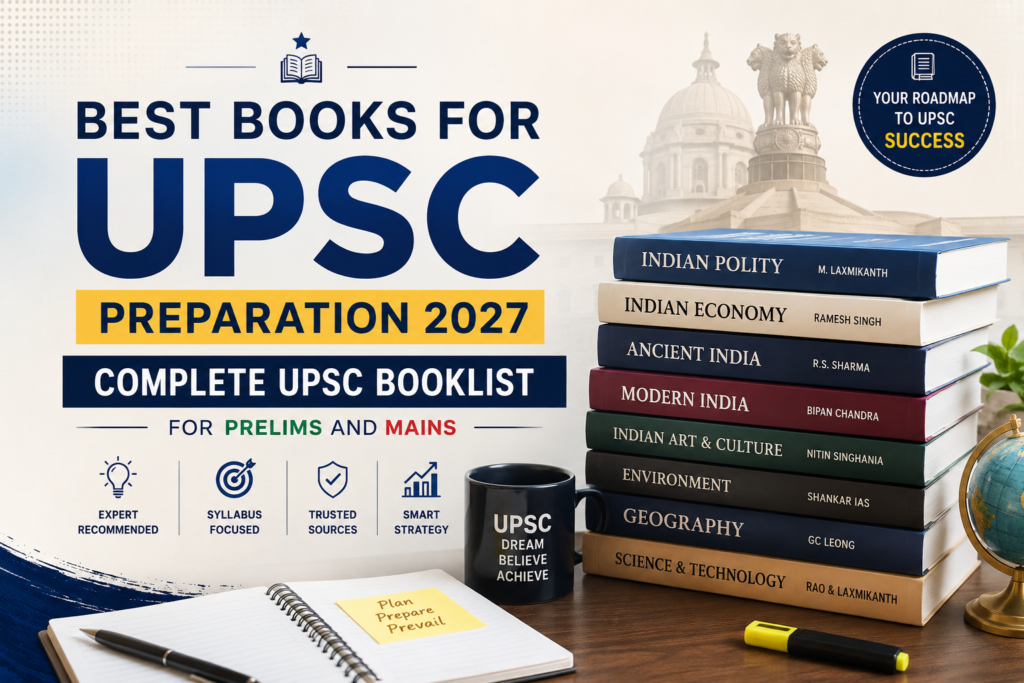
Preparing for the UPSC Civil Services Examination is one of the most challenging yet rewarding journeys in India. Every year, lakhs of aspirants begin their preparation with excitement, only to get overwhelmed by endless booklists, coaching materials, PDFs, Telegram channels, and YouTube recommendations.
The reality is simple: UPSC is not about reading everything. It is about reading the right books repeatedly.
Most toppers and reputed UPSC mentors consistently recommend a limited set of standard books combined with NCERTs, current affairs, revision, and PYQ analysis. Research across major UPSC blogs and topper strategy videos shows one common pattern — successful aspirants avoid resource overload and focus on conceptual clarity.
This article provides a complete UPSC beginner booklist for Prelims and Mains 2027, specially curated for:
- Beginners
- Working professionals
- Serious aspirants
- Self-study candidates
Why Choosing The Right UPSC Books Matters
Many beginners fail not because they lack intelligence, but because they lack direction.
Aspirants often make mistakes like:
- Buying too many books
- Following multiple toppers blindly
- Switching resources frequently
- Ignoring revision
- Collecting PDFs instead of studying
Experienced mentors repeatedly emphasize:
“Read fewer books multiple times.”
The right booklist:
- Builds conceptual clarity
- Saves preparation time
- Reduces confusion
- Improves retention
- Helps in answer writing
- Makes revision manageable
NCERTs, combined with standard books, remain as the backbone of preparation for the majority of toppers.
Best NCERT Books For UPSC Beginners
NCERT books are the foundation of UPSC preparation. Most toppers strongly recommend completing NCERTs before moving to advanced books.
History
- Class 6–12 History NCERTs
- Old NCERT Ancient India – R.S. Sharma
- Old NCERT Medieval India – Satish Chandra
Geography
- Class 6–12 Geography NCERTs
Polity
- Class 9–12 Political Science NCERTs
Economics
- Class 11 & 12 Economics NCERTs
Science
- Class 6–10 Science NCERTs
NCERTs help beginners understand basic concepts in simple language and create a strong foundation for advanced preparation.
Best Standard Books For UPSC Prelims
After completing NCERTs, aspirants should move to standard reference books.
Indian Polity
Indian Polity – M. Laxmikanth
This is considered the “Bible” of UPSC Polity preparation and is recommended by almost every topper and coaching institute.
Why important:
- Easy language
- Prelims + Mains useful
- Covers Constitution comprehensively
Modern History
Spectrum – A Brief History of Modern India
Spectrum remains the most recommended history book for UPSC beginners.
Why important:
- Crisp content
- Excellent for revision
- Highly Prelims-oriented
Geography
GC Leong – Certificate Physical Geography
GC Leong is one of the most trusted geography books for UPSC.
Use it with:
- NCERT Geography
- Atlas practice
Environment
Shankar IAS Environment
Environment has become increasingly important in UPSC Prelims.
Why important:
- Covers ecology basics
- Good for current affairs linkage
- Prelims-focused content
Recommended by several UPSC platforms and topper discussions.
Economy
Indian Economy – Ramesh Singh
Useful for beginners who struggle with economics concepts.
Alternative:
- NCERT + Current Affairs approach
Art & Culture
Nitin Singhania – Indian Art and Culture
Best for:
- Culture basics
- Temple architecture
- Classical dances
- Paintings and traditions
Highly recommended in topper booklists
BOOKLIST TABLE FOR EASY UNDERSTANDING
POLITY
| Name of the Book | Published By | Purpose |
Scope |
Indian Constitution at Work |
NCERT Class 11 | Read this first to understand the basics of how the constitution works | Both (Prelims and Mains). Read entirely. |
Indian Polity |
M. Laxmikanth(Latest edition) If you are having old edition, current affairs should be updated for static areas as these are the main source of prelims questions. |
Read after the NCERT | Primarily Prelims. Read entirely |
| Political Theory | NCERT | Read after Laxmikanth. Explains basic concepts like separation of powers and constitutional government; useful for conceptual PYQs. Focus on chapters like Secularism, Liberty, and Equality to clear political concepts. |
Both (Prelims and Mains). Prioritize based on the frequency of PYQ’s |
HISTORY
| Name of the Book | Published By | Purpose |
Scope |
Ancient India |
OLD NCERT Class 11 R. S. SHARMA |
Bare minimum resource Reprinted editions available on Amazon. |
Read entirely. Both (Prelims and Mains) |
Medieval India |
OLD NCERT Class 12 Satish Chandra |
Bare minimum resource Reprinted editions available on Amazon. |
Read entirely. Both (Prelims and Mains) |
| Introduction to Indian Art | NCERT Class 11 | Contains numerous images (e.g. halos behind Buddha statues) and illustrations (e.g.Sanchi Stupa) that help explain concepts. Helps with visual memory for the exam. |
Highly recommended Read entirely Both (Prelims and Mains) |
| Themes in Indian History Part 1 & 2 | NCERT Class 12 | Focus more on Art and Culture (e.g: Vijayanagara Empire, Bronze casting) Includes many images Direct questions in exams. |
Focus less on general history and more on art/culture. Both (Prelims and Mains) |
Indian Art and Culture |
Nitin Singhania | PYQ’S of prelims and mains are given at the end of each chapter. | Bulky book. Refer most important parts only. Prioritize based on the PYQ frequency. |
| Modern History | A Brief History of Modern India (Spectrum Publications) |
Covers everything; good for comprehensive coverage. Focus only on the part until Independence; avoid post-independence chapters during the prelims phase. |
Now 1100–1200 pages (formerly 600–700); lacks efficiency due to excessive page count; retrospective additions of questions make it bulky. Both (Prelims and Mains) |
Plassey to Partition |
Sekhar Bandyopadhyay | Best book for Prelims and Mains history in about 500–550 pages; once done, no other source needed | Slightly dense; absolutely no images, making it harder for visual memory. |
| Modern India Old NCERT | Bipin Chandra | Simplified version of bigger texts. | A very abridged version; many things are missed; basic questions might not be solvable using only this book. Good for Prelims |
Post-Independence |
A Brief History of Modern India Spectrum Publications (Post-Independence section) |
Read briefly in summary format; do not spend too much time as it only yields one question | MAINS ONLY |
| World History | Norman Lowe | Great for students with History Optional | MAINS ONLY 700 pages for a subject (World History) that usually has only one question in Mains; low ROI (Return on Investment). So prioritize the preparation based on the frequency of PYQ’s |
GEOGRAPHY
| Name of the Book | Published By | Purpose |
Scope |
Fundamentals of Physical Geography |
NCERT Class 11 | Read first to understand broad physical geography concepts. Best book ever; direct questions in both Prelims and Mains from almost every chapter. |
Both (Prelims and Mains). Read entirely. |
Certificate Physical and Human Geography |
GC Leong |
Use as a reference for physical geography chapters where NCERT lacks explanation. Contains many diagrams that make concepts easier to understand; specifically strong on Climatic Regions. |
Read Part 1 completely, only summary of Part 2. Both (Prelims and Mains) |
India: Physical Environment |
NCERT Class 11 | Read after understanding physical geography concepts to understand Indian geography. |
Both (Prelims and Mains) Read entirely. |
Fundamentals of Human Geography |
NCERT (Class 12) | Read in reference to Economy as the data is slightly outdated; do not read as stand-alone books. | Low ROI; students often feel like they haven’t gained much after reading the whole book Both (Prelims and Mains) Read entirely. |
| India: People and Economy | NCERT (Class 12) | Read in reference to Economy as the data is slightly outdated; do not read as stand-alone books. | Both (Prelims and Mains) Read entirely. |
| Oxford School Atlas | Oxford | Essential for visualization and retention; necessary to look at maps while studying Geography. | Use alongside NCERTs; essential for scoring marks. |
ECONOMY
| Name of the Book | Published By | Purpose |
Scope |
Indian Economic Development |
NCERT Class 11 | Covers economic history from 1947, Five-Year Plans, and LPG reforms. |
Read entirely (First book to read).Requires additional current affairs study after reading. |
Indian Economy |
Vivek Singh |
Buy the latest edition as economy is highly dynamic. Also, current affairs linkage is very important as the changes in policies mainly leads to questions. | Read entirely. Both Prelims and Mains |
| Economy Notes/Book | Mrunal Patel | Greatest place to study economy; very approachable and easy to cover. |
1100 pages; the massive volume makes completing it a significant challenge Both (Prelims and Mains). Follow Vivek Singh/Mrunal based on the complexity of the topic as Vivek singh book is slightly technical but Mruanl’s book is simple and easy to understand. |
ENVIRONMENT
| Name of the Book | Published By | Purpose |
Scope |
Environment |
Shankar IAS |
Great book for theory; must be supplemented with current affairs. |
Read entirely. Both (Prelims and Mains) |
SCIENCE AND TECHNOLOGY
| Name of the Book | Published By | Purpose |
Scope |
SCIENCE AND TECHNOLOGY |
Ravi P. Agrahari | Uses many infographics and diagrams; takes the reader from zero/basics level. |
Read to clear basics (thick book). Current Affairs is very important in Science and Tech. |
| SCIENCE | NCERT 6-10 (Mainly 9th and 10th) SELECTIVE STUDY OF 11 & 12 NCERT |
Basic understanding of the concepts needed. | Prioritize topics based on the frequency of PYQ’s for better |
Best Books For UPSC Mains
UPSC Mains requires analytical understanding and answer writing practice.
Ethics (GS Paper IV)
- Lexicon for Ethics
- Ethics Notes + PYQs
Essay
- Reading editorials
- Practice essays weekly
- Model essays from toppers
Governance & Society
- ARC Summary Reports
- Current affairs integration
International Relations
- Newspaper editorials
- MEA website references
Several UPSC experts now recommend integrating current affairs with static subjects instead of depending entirely on bulky books.
Best Current Affairs Sources For UPSC
Current affairs play a major role in both Prelims and Mains.
Recommended Sources:
- The Hindu
- Indian Express
- PIB
- Yojana
- Kurukshetra
- Economic Survey
- Monthly compilations
Experts repeatedly advise aspirants to follow one newspaper consistently instead of consuming multiple sources.
Best Book Strategy For Working Professionals
Working professionals preparing for UPSC should avoid excessive resources.
Smart Strategy:
- Limited books
- 3–4 study hours daily
- Audio learning during commute
- Weekend revision
- PYQ-focused preparation
Recommended approach:
- Complete NCERTs first
- Add one standard book per subject
- Practice MCQs regularly
- Revise continuously
Consistency matters more than long study hours.
Biggest Mistakes UPSC Beginners Make
1. Buying Too Many Books
More books do not guarantee success.
2. Ignoring PYQs
Previous year questions reveal UPSC trends.
3. Delaying Revision
Without revision, retention becomes weak.
4. Following Too Many Mentors
Stick to one strategy.
5. Ignoring Answer Writing
Mains requires writing practice from the beginning.
Ideal UPSC Beginner Booklist (Short Version)
| Subject | Best Book |
|---|---|
| Polity | M. Laxmikanth |
| Modern History | Spectrum |
| Geography | GC Leong |
| Environment | Shankar IAS |
| Economy | Ramesh Singh |
| Culture | Nitin Singhania |
| Current Affairs | The Hindu + PIB |
Final Thoughts
The UPSC Civil Services Examination is not a test of how many books you can collect. It is a test of clarity, consistency, revision, and discipline.
Most toppers use limited resources but revise them deeply. The winning formula remains:
- NCERT foundation
- Standard books
- Current affairs integration
- PYQ analysis
- Consistent revision
- Mock tests and answer writing
If you are a beginner in 2026, remember this:
Do not chase too many resources.
Master a few trusted books completely.
That alone can place you ahead of thousands of aspirants.
Start Smart With ELEARNIAS
At ELEARNIAS, we simplify UPSC preparation through:
- Beginner-friendly strategies
- Smart booklists
- Daily current affairs
- PYQ-based preparation
- AI-powered learning systems
- Structured study plans
Learn Smart. Lead India.