
Why Most Aspirants Fail Before They Even Begin
Every year, lakhs of aspirants start preparing for UPSC Civil Services Examination with massive motivation. They buy books, enroll in courses, watch topper videos, and make elaborate timetables.
Yet, most of them ignore the single most important document in UPSC preparation:
The UPSC Syllabus.
The syllabus is not just a list of subjects. It is the blueprint of the entire examination.
UPSC never asks questions outside its syllabus. But the challenge is:
- UPSC asks indirectly
- UPSC uses interdisciplinary framing
- UPSC tests analytical understanding, not rote learning
For example, a simple syllabus keyword like “environment” can generate questions on:
- Climate change
- Biodiversity treaties
- Critical minerals
- Green hydrogen
- Carbon markets
- Mangrove ecosystems
- Electric vehicles
The UPSC syllabus is therefore:
- a preparation roadmap,
- a resource filter,
- a revision framework,
- and the foundation of answer writing.
The aspirants who repeatedly revise the syllabus and connect it with Previous Year Questions (PYQs) gain a huge advantage.
Recent UPSC Prelims papers clearly show how conceptual and interdisciplinary the exam has become. Questions on ecology, AI, uranium, infrastructure connectivity, geography, and governance dominate the exam pattern.
This article will help you:
- Understand the complete UPSC Syllabus 2027
- Decode hidden meanings behind syllabus keywords
- Understand Prelims vs Mains preparation
- Learn optional subject strategy
- Analyze PYQ trends
- Build a realistic preparation roadmap
By the end, you will know exactly:
What to study, what not to study, and how UPSC actually thinks.
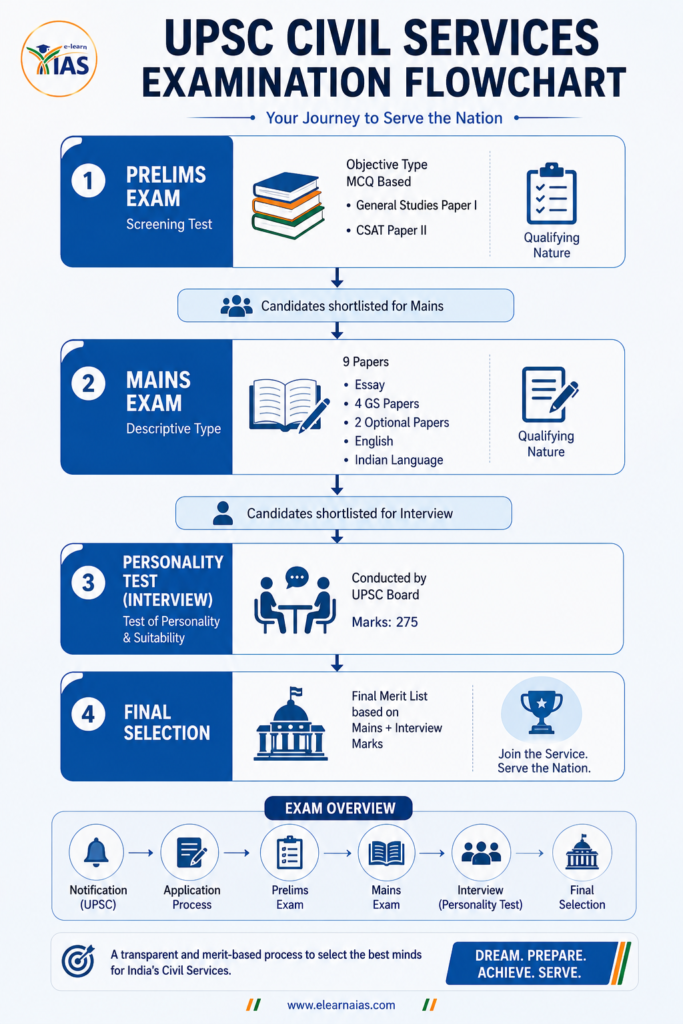
UPSC Exam Structure 2027 – Complete Overview
The UPSC Civil Services Examination (CSE) is conducted in three stages:
| Stage | Nature | Marks |
|---|---|---|
| Prelims | Screening Test | 400 |
| Mains | Written Examination | 1750 |
| Interview | Personality Test | 275 |
Total Marks for Final Merit:
2025 Marks
Stage 1: UPSC Prelims Examination
Papers
| Paper | Subject | Marks |
|---|---|---|
| GS Paper 1 | General Studies | 200 |
| GS Paper 2 | CSAT | 200 |
Important Points
- Objective type (MCQs)
- Negative marking
- CSAT is qualifying (33%)
- GS Paper 1 determines cutoff
Stage 2: UPSC Mains Examination
Papers in Mains
| Paper | Subject | Marks |
|---|---|---|
| Paper A | Indian Language | 300 |
| Paper B | English | 300 |
| Essay | Essay | 250 |
| GS 1 | History, Geography, Society | 250 |
| GS 2 | Governance, Constitution, IR | 250 |
| GS 3 | Economy, Science, Security | 250 |
| GS 4 | Ethics | 250 |
| Optional Paper 1 | Optional Subject | 250 |
| Optional Paper 2 | Optional Subject | 250 |
Language papers are qualifying.
Stage 3: UPSC Personality Test (Interview)
Marks: 275
UPSC assesses:
- Mental alertness
- Decision-making
- Administrative aptitude
- Ethical reasoning
- Communication skills
- Balanced judgment
UPSC Prelims Syllabus 2027 Explained
The Prelims syllabus appears short on paper, but UPSC asks highly analytical questions.
UPSC Prelims Syllabus
Paper I – (200 marks) Duration : Two hours
- Current events of national and international importance.
- History of India and Indian National Movement.
- Indian and World Geography – Physical, Social, Economic Geography of India and the World.
- Indian Polity and Governance – Constitution, Political System, Panchayati Raj, Public Policy, Rights
- Issues, etc.
- Economic and Social Development Sustainable Development, Poverty, Inclusion, Demographics,
- Social Sector initiatives, etc.
- General issues on Environmental Ecology, Bio-diversity and Climate Change – that do not require
- subject specialization.
- General Science
Paper II- (200 marks) Duration: Two hours
- Comprehension
- Interpersonal skills including communication skills;
- Logical reasoning and analytical ability
- Decision-making and problem-solving
- General mental ability
- Basic numeracy (numbers and their relations, orders of magnitude, etc.) (Class X level), Data
- interpretation (charts, graphs, tables, data sufficiency etc. – Class X level)
- English Language Comprehension skills (Class X level).
The Core areas for prelims are:
- Current events
- History
- Geography
- Polity
- Economy
- Environment
- Science & Technology
Let us decode each section.
As the syllabus is vast, following a strict UPSC Booklist is always important.
1. History
Topics Covered
- Ancient India
- Medieval India
- Modern India
- Freedom Struggle
- Art & Culture
What UPSC Actually Asks
UPSC now focuses less on factual chronology and more on:
- cultural significance,
- socio-economic changes,
- ideological evolution,
- architecture and art.
Example:
Recent Mains questions on Harappan architecture and Akbar’s religious syncretism reflect conceptual depth.
Important Areas
- Buddhism & Jainism
- Temple architecture
- Bhakti-Sufi movements
- Governor Generals
- Gandhian movements
- Constitutional development
2. Geography
Static Geography
- Physical geography
- Indian geography
- Climatology
- Oceanography
Dynamic Geography
- Climate change
- El Niño
- Sea level rise
- Urbanization
- Agriculture
Recent questions on island nations and climate change show UPSC’s interdisciplinary approach.
High-Yield Areas
- Mapping
- Rivers
- Mountains
- Monsoon
- Agriculture
- Mineral resources
- Environmental geography
3. Indian Polity
Important Topics
- Constitution
- Fundamental Rights
- Parliament
- Judiciary
- Federalism
- Constitutional bodies
UPSC increasingly asks application-based polity questions rather than direct articles.
Focus Areas for 2027
- Constitutional morality
- Tribunals
- Federal relations
- Electoral reforms
- Digital governance
Recent GS2 PYQs emphasize constitutional morality and accountability.
4. Economy
Topics
- Inflation
- Banking
- Fiscal policy
- Budget
- External sector
- Growth & development
UPSC Trend
Questions are becoming:
- conceptual,
- statement-based,
- linked with current affairs.
Example:
Questions related to monetary policy and central banks appeared in recent papers.
Important Areas for 2027
- AI economy
- Green economy
- Semiconductor ecosystem
- Digital rupee
- Inflation
- Employment
- Energy transition
5. Environment & Ecology
This is among the most important UPSC areas now.
Key Topics
- Biodiversity
- Protected areas
- Climate agreements
- Species
- Pollution
- Renewable energy
Recent Prelims papers show massive focus on:
- ecology,
- forests,
- invasive species,
- microorganisms,
- climate change.
Examples visible in recent PYQs include:
- invasive species,
- biodiversity,
- mushrooms,
- ecology-based conceptual questions.
Most Important Preparation Strategy
- Integrate current affairs with static ecology.
- Focus on species + habitat + conservation status.
6. Science & Technology
UPSC asks:
- applied science,
- emerging technology,
- governance implications.
Important Topics
- AI
- Quantum computing
- Biotechnology
- Space
- Drones
- Semiconductor technology
- Cybersecurity
Recent Mains PYQs directly asked AI + GIS integration in planning.
7. Current Affairs
Current affairs are integrated into every subject.
UPSC does NOT ask newspaper trivia.
It asks:
- conceptual application,
- governance linkage,
- analytical understanding.
Best Books For UPSC Preparation 2027-COMPLETE UPSC BOOKLIST FOR PRELIMS AND MAINS
CSAT Syllabus 2027
CSAT includes:
- Reading comprehension
- Logical reasoning
- Decision making
- Basic numeracy
- Data interpretation
Important Reality
Many aspirants ignore CSAT and fail despite good GS preparation.
2027 Strategy
- Practice comprehension regularly
- Solve previous CSAT papers
- Focus on time management
Hidden Nature of UPSC Prelims
Modern UPSC Prelims has changed significantly.
Earlier Pattern
- Factual
- Direct
- NCERT-based
Current Pattern
- Analytical
- Statement-based
- Elimination-heavy
- Interdisciplinary
Example:
A question may combine:
- geography,
- economy,
- environment,
- current affairs,
in a single MCQ.
UPSC Mains Syllabus 2027 Explained
PAPER A – INDIAN LANGUAGES
Mains is not about information dumping.
It tests:
- analytical ability,
- balanced thinking,
- multidimensional understanding,
- articulation.
Essay Paper
Marks: 250
UPSC tests:
- philosophical thinking,
- structure,
- clarity,
- examples,
- balance.
Common Themes
- Technology
- Democracy
- Ethics
- Society
- Women
- Development
- Environment
GS Paper 1
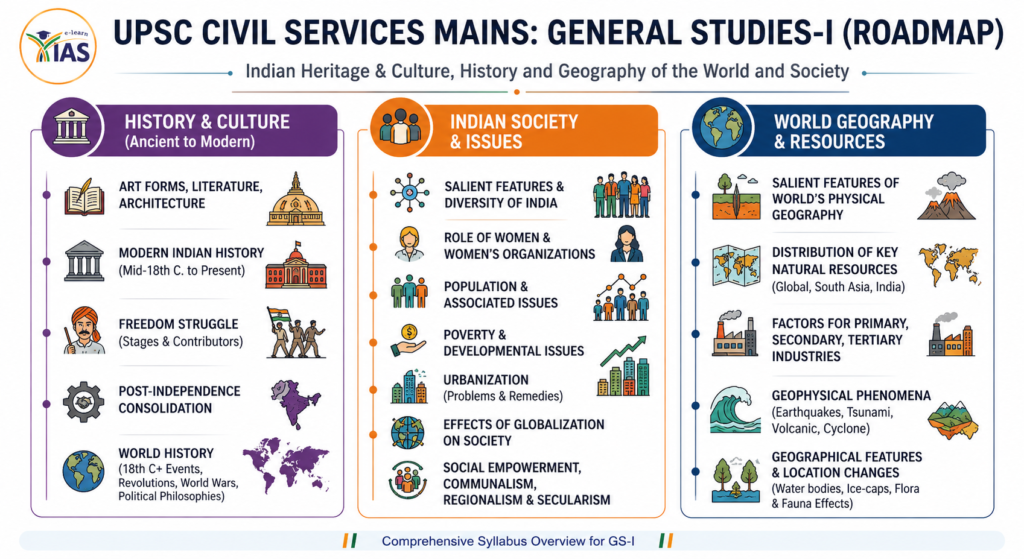
Topics
- Indian Heritage
- Modern History
- Society
- Geography
Important Themes
- Urbanization
- Globalization
- Women issues
- Population
- Climate change
Example:
Questions on fast-food culture, sustainable development, tribal development, and tectonic movements show interdisciplinary thinking.
GS Paper 2
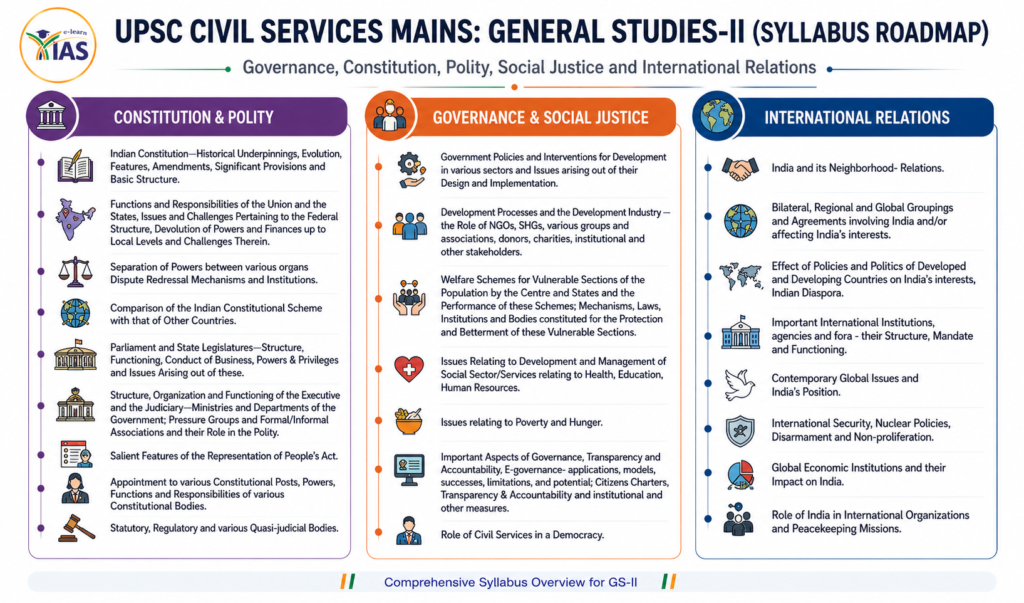
Topics
- Constitution
- Governance
- Parliament
- Judiciary
- Welfare schemes
- International Relations
Emerging Themes
- Digital governance
- Tribunal reforms
- Constitutional morality
- Federalism
- Civil society
Recent PYQs include:
- tribunal reforms,
- collegium system,
- child rights in digital era,
- constitutional morality.
GS Paper 3
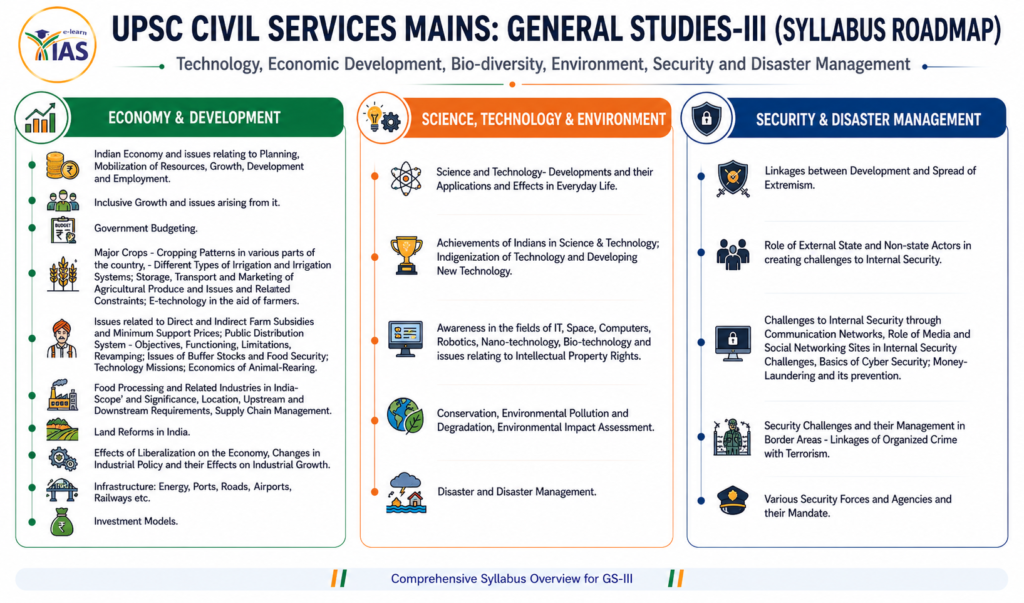
Topics
- Economy
- Agriculture
- Environment
- Internal security
- Science & Technology
Important 2027 Focus Areas
- AI governance
- Climate finance
- Critical minerals
- Cybersecurity
- Green hydrogen
- Food security
GS Paper 4 (Ethics)
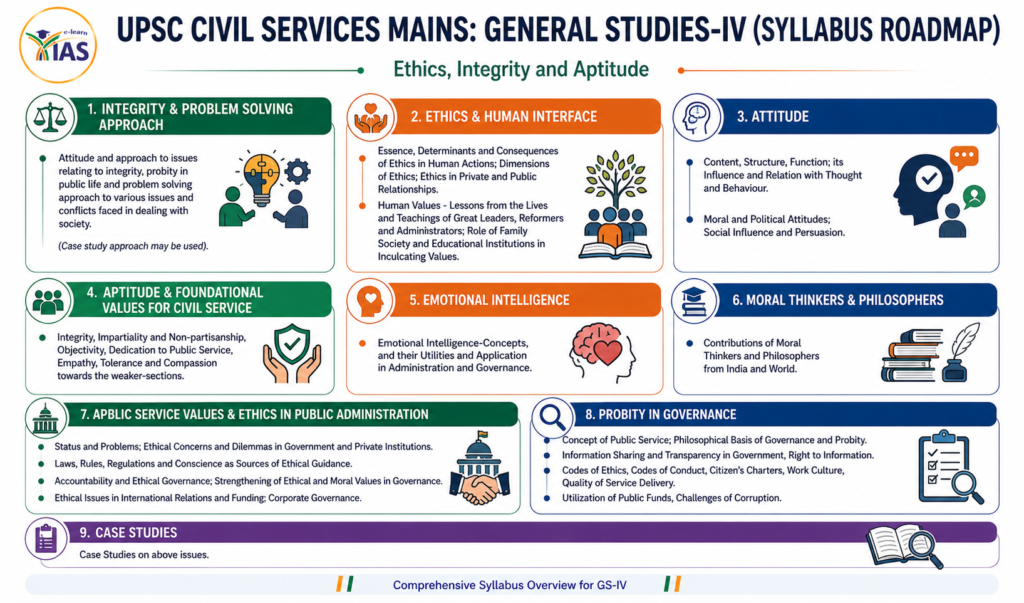
Topics
- Ethics
- Integrity
- Aptitude
- Emotional intelligence
- Case studies
What UPSC Wants
- Practical ethics
- Administrative morality
- Balanced decisions
What UPSC Actually Tests in Mains
UPSC evaluates:
- conceptual clarity,
- multidimensionality,
- problem-solving ability,
- governance understanding,
- ethical balance.
It does NOT reward:
- rote memorization,
- coaching notes reproduction,
- generic answers.
How to Choose Optional Subject for UPSC 2027
This is one of the biggest decisions in preparation.
Complete Optional Subjects List
Popular optionals include:
- Anthropology
- Sociology
- PSIR
- Geography
- History
- Public Administration
- Philosophy
- Literature subjects
Factors to Choose Optional
1. Interest
Never choose optional only because toppers selected it.
2. Syllabus Size
Some optionals are:
- concise,
- technical,
- vast,
- dynamic.
3. Overlap with GS
Examples:
| Optional | GS Overlap |
|---|---|
| PSIR | GS2 + Essay |
| Sociology | Society + Essay |
| Geography | GS1 + Environment |
| Anthropology | Science + Society |
4. Availability of Guidance
Good mentorship matters.
5. PYQ Compatibility
Analyze:
- question repetition,
- predictability,
- conceptual nature.
Myth vs Reality About Optional Subjects
| Myth | Reality |
|---|---|
| One optional guarantees selection | No optional guarantees rank |
| Technical optional always scores more | Depends on preparation |
| Small syllabus means easy optional | Depth matters |
| Popular optional is safest | Fit matters more |
UPSC Syllabus Overlap Strategy
Smart aspirants prepare integrated subjects.
Prelims + Mains Overlap
Example
Environment:
- Prelims → species, ecology
- Mains → climate governance
Polity:
- Prelims → constitutional provisions
- Mains → governance analysis
GS + Essay Overlap
Topics like:
- women,
- technology,
- democracy,
- climate change,
appear across papers.
Beginner’s Strategy to Complete UPSC Syllabus
Phase 1: Foundation (3–4 Months)
Focus:
- NCERTs
- Basic concepts
- Newspaper reading
Phase 2: Standard Books (4–5 Months)
Build:
- advanced understanding,
- notes,
- revision system.
Phase 3: PYQ + Test Series
Analyze:
- question trends,
- answer patterns,
- elimination techniques.
Phase 4: Revision Cycle
UPSC rewards revision more than excessive resources.
Ideal revision cycle:
- 1 day
- 7 days
- 30 days
Common Mistakes Aspirants Make
1. Ignoring Syllabus Language
Every keyword matters.
2. Resource Overload
Too many books destroy revision.
3. Ignoring PYQs
PYQs are the closest thing to UPSC thinking.
4. No Revision
Without revision:
- retention collapses,
- confidence falls,
- accuracy declines.
5. Current Affairs Obsession
UPSC does not reward random fact accumulation.
Best Sources for UPSC Syllabus Preparation
| Subject | Core Sources |
|---|---|
| History | Spectrum + NCERT |
| Geography | NCERT + Atlas |
| Polity | Laxmikanth |
| Economy | Basic NCERT + Current Affairs |
| Environment | Current Affairs + Standard Notes |
| Ethics | Lexicon + Case Practice |
Highly Optimized FAQs
Is UPSC syllabus same every year?
Mostly yes. Minor changes are rare.
Is NCERT enough for UPSC?
NCERTs build foundation but are not sufficient alone.
How many hours should beginners study?
Quality matters more than fixed hours.
Which optional subject is best?
The best optional is:
- interesting,
- manageable,
- and suitable to your strengths.
Can beginners complete syllabus in 1 year?
Yes, with:
- proper planning,
- revision,
- PYQ analysis,
- disciplined execution.
Is current affairs enough for UPSC?
No. Static + current integration is essential.
Final Conclusion
The UPSC syllabus is not vast because of its length.
It feels vast because:
- topics are interconnected,
- current affairs continuously evolve,
- and UPSC tests analytical maturity.
If you deeply understand the syllabus:
- book selection becomes easier,
- revision becomes faster,
- answer writing improves,
- and preparation becomes focused.
The real secret of UPSC preparation is not studying everything.
It is:
studying the right things repeatedly with conceptual clarity.
The aspirants who continuously:
- revise the syllabus,
- analyze PYQs,
- integrate current affairs,
- and think analytically,
eventually gain a decisive edge.
And that is exactly how serious aspirants should approach UPSC 2027